
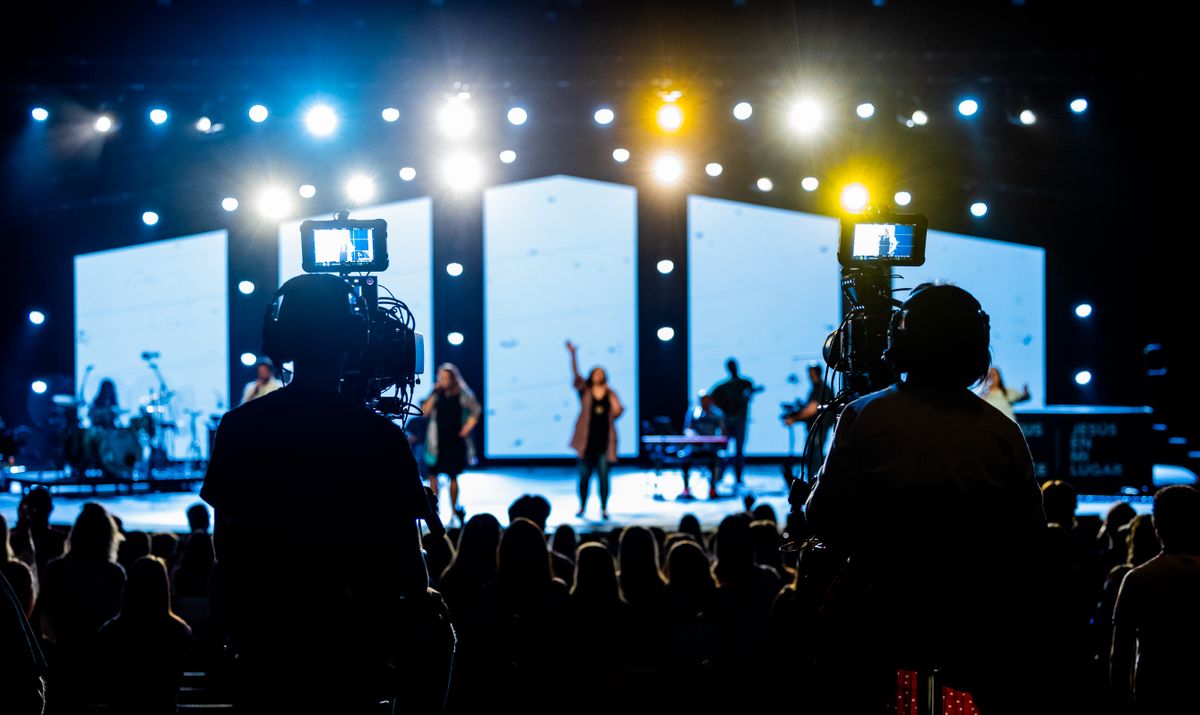
Placement beats equipment
Given a choice between better cameras in poor positions and modest cameras in good ones, take the positions every time. Placement determines what the shot is. Equipment only determines how cleanly it is captured.
This is good news, because placement is free.
Height is the thing people get wrong
The most common reason a stream looks amateur has nothing to do with resolution. It is camera height.
Eye level reads as normal. A camera at roughly the height of a standing adult's eyes produces a shot that feels like being in the room. This is what you want for almost everything.
Above eye level reads as surveillance. A camera on a balcony or high bracket looks down. Faces foreshorten, people appear small and diminished, and the viewer's relationship to the room becomes detached. It reads like security footage, because security footage is mounted this way.
Below eye level reads as odd. A camera on a low tripod looks up. Nostrils, ceilings, unflattering angles.
A high mounting point is often chosen because it is out of the way and has a clear view over the audience. Both are real advantages, and they cost you the shot. If you must mount high, get as low as sightlines permit and it will improve immediately.
The main position
Start with one camera and get it right.
On the centre line, or close. A camera significantly off to one side means the speaker is permanently in profile or turned away.
At eye level.
Far enough back to hold the whole area of interest without needing adjustment. A shot that requires someone to reframe is a shot that will be wrong when nobody is watching it.
Where it will not be walked into. A tripod in a walkway will be knocked. Behind a row of seats, against a wall, or on a stable mount.
Where the operator can see it. If you can see the camera and the screen simultaneously, you notice when something is wrong.
This one position, done well, is a complete stream. Everything else is addition.
When to add a second
Add one when the interesting thing moves between two places... a speaker and a band, a lectern and a table, a stage and a screen.
Do not add one merely to cut between angles. Cutting between two similar wide shots does not improve anything and gives the operator work to do.
If you do add one:
Make it clearly different. A close shot against a wide one, or a genuinely different angle. Two similar shots produce a cut that reads as a mistake... a small jump rather than a change.
Cross the room, do not sit beside. Two cameras a metre apart give you almost the same picture twice.
Decide its job in advance. "This is the close shot on whoever is speaking." A camera without a defined job becomes a camera someone has to think about live.
Rooms with awkward shapes
A wide room. The centre line may be far back, making everything small. Consider a closer camera slightly off-centre rather than a distant central one; being close matters more than being centred.
A long narrow room. The opposite problem... the centre line is a long way from the front. A camera further forward and to one side is often better than a distant straight-on shot.
A balcony and nothing else. If the only mounting point is high, angle down as little as possible and prefer a tighter shot. A tight high shot is more forgiving than a wide high shot, because there is less floor in frame to signal the height.
Windows behind the subject. The most common lighting mistake. A camera pointed at a bright window makes everyone in front of it a silhouette. Either close the blinds or move the camera so the window is behind it.
A dark stage. Cameras need considerably more light than eyes do. If the room is atmospheric, the stream will be noisy and soft. Sometimes the answer is to accept it; sometimes a modest amount of light on the speaker's face changes everything.
Framing that survives
Because the shot must hold without supervision:
Leave room around the subject. A tight shot becomes wrong the moment somebody moves. A little space is insurance.
Frame for where they will be, not where they are. People move during an event, usually forward and toward the centre.
Leave headroom, not too much. A small gap above the head. A large gap makes people look small; none looks cramped.
Check with the room full. People change sightlines. A camera with a perfect view of an empty room may be looking at the back of someone's head.
Phones specifically
If your cameras are phones:
Fix them properly. A phone balanced on something will move. Any clamp or tripod mount is worth having.
Landscape, always. Vertical video in a horizontal frame wastes most of the picture.
Charging. A phone that dies mid-event is an entirely avoidable failure. Power at each position.
Clean the lens. Genuinely. Phone lenses live in pockets, and a smeared lens produces a soft, hazy image that looks like a camera fault.
The short version
One camera, eye level, on the centre line, far enough back to hold the shot without adjustment. Not on the balcony. Not pointed at a window. Framed with a little room to spare, checked with the room full.
That is a good stream. A second camera helps when the interesting thing genuinely moves... and a single well-placed camera beats three badly placed ones, every time.