
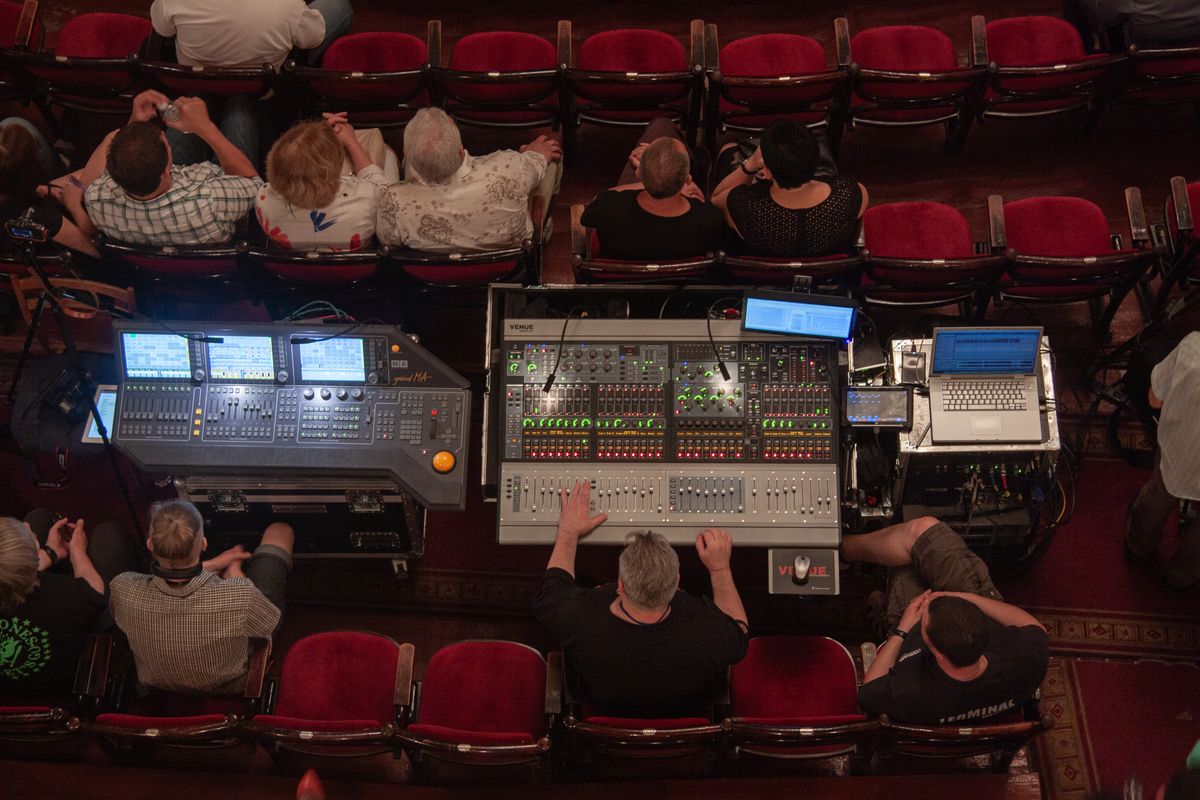
The gap in the market
Conference AV divides into two tiers that do not meet in the middle.
At the top, a production company: a crew, a rack of equipment, a proper budget. Excellent, and priced accordingly.
At the bottom, someone's laptop plugged into a projector, a recording nobody watches, and no stream.
A great many events sit in the gap. A one-day conference. A training day. An AGM. A community summit. A hundred to three hundred people, real speakers, a genuine desire to record and stream it... and a budget that does not extend to a crew.
That gap is very coverable by a small team, and this is what it takes.
What a conference actually needs
Different from a service in specific ways, and the differences are where in-house teams get caught out.
Slides are the main content. For most conference talks, the slide is what matters more than the speaker's face. This inverts the usual priority... your primary output is often a slide with a small speaker inset rather than the reverse.
Speakers bring their own material. The single hardest part, and it is a people problem more than a technical one. Every speaker has different files, different aspect ratios, different fonts, and one of them will want to play a video with sound.
Timing is enforced. Conferences run to a schedule. Somebody has to tell speakers how long they have left, and doing it well is a real job.
The recording is a deliverable. Often the point. People who paid to attend expect to review it; people who could not come expect access. A recording that failed is a promise broken to a paying audience.
The audience is judgemental in a specific way. A conference audience contains people who have been to good conferences. They will not comment on smooth production and will absolutely notice a stumble.
A setup that covers it
A laptop running the production, positioned where the operator can see the stage and the screen.
One camera on the speaker, wide enough to survive movement. A second, closer camera if you have someone to run it.
Slides through the production, not straight from a speaker's laptop to the projector. This is the important architectural decision, and I will come back to it.
A timer visible to the speaker, and a way to send them a short message. "Five minutes." "Please wrap up." Seen by the speaker, invisible to the audience.
Audio from the room's sound system. As always, the microphone feed rather than the room's ambience.
Recording running the whole time, verified at the start rather than assumed.
The speakers' laptops problem
This is where in-house conference AV most often fails, so it deserves the detail.
The tempting arrangement is that each speaker plugs their own laptop into the projector. It seems simplest. It is not.
Every changeover is a risk. Cable swaps, resolution renegotiation, a display that does not wake, a laptop that shows the wrong screen. Multiply by the number of speakers and something will go wrong in front of everyone.
Your stream and recording lose the slides. If slides go straight to the projector, they are not in your production, so the remote audience sees a speaker gesturing at something they cannot see. This ruins the recording as a deliverable.
You cannot control what appears. Notifications, desktop wallpaper, the last thing they had open. Everyone has seen this happen.
The better arrangement: collect the decks in advance, run them from your machine, and give each speaker a way to advance their own slides from their phone. Now every changeover is selecting the next deck. The slides are in your recording. Nothing unexpected appears on the projector.
The cost is administrative... you have to chase people for files, and someone will send theirs during the coffee break. That is a real cost and it is much smaller than the alternative.
When a speaker insists on their own machine (and some will, usually for a live demonstration) treat it as a special case with its own plan: test it in the break beforehand, know how you will get it into the recording, and accept that this segment carries more risk.
Where a small team is genuinely enough
One room, one track. The moment there are parallel sessions, you need multiple setups and multiple operators, and the coordination problem becomes the job.
A modest audience. A few hundred people in one room is well within reach.
A day, not a week. Multi-day events accumulate fatigue, and a tired volunteer team on day three is a different proposition.
Stakes you can absorb. If a failure means an awkward ten minutes, in-house is fine. If it means refunds, reconsider.
Where to hire in
Being straight about this, because the answer is not always "do it yourself."
Large rooms. Beyond a certain size, the audio and screen requirements stop being a small-team job.
Multiple simultaneous tracks. The coordination overhead grows faster than the number of rooms.
Events where failure is commercially unacceptable. If you sold tickets on the promise of a stream, the stream needs to work, and a professional crew is insurance you are buying deliberately.
When your team is also attending. A frequently missed consideration. If the people who would run AV are the people who need to be in the room participating, in-house is not free... it costs you their attendance.
Practical points
Rehearse the changeover, not the talks. Transitions between speakers are where things break. Practise those specifically.
Have a holding slide. Something to put up during a problem that is not a frozen frame or a desktop. It converts a visible failure into an apparent interlude.
Start the recording before the first speaker and stop it after the last. Trimming afterwards is trivial. Recovering a missed start is impossible.
Check the recording at the first break. Not at the end. If something is wrong, you want to know while there is still a conference left to record.
Decide in advance who makes the call if something fails. In the moment, an event needs one person deciding whether to continue, pause or drop the stream. Agreeing that beforehand takes a minute and saves a bad five.
The summary
A single-room, single-day conference is well within a small team's reach. Collect the decks in advance and run them yourself; put a timer where the speaker can see it; take audio from the desk; verify the recording early.
The failures that actually happen are not exotic. They are the changeover between speakers and a recording nobody checked. Solve those two and you have covered most of the distance to a professional-feeling event.