
The audience that cannot come
A school hall seats a few hundred. The audience for a graduation, a concert or a prize day is larger than that, and a meaningful part of it is not in the country.
Grandparents overseas. A parent working abroad. Siblings at university. Family who would travel for a wedding but not for a Tuesday afternoon prize-giving, and who would still very much like to watch it.
This is one of the clearest cases for streaming, and school teams often do not attempt it because the setup looks like a production. It does not have to be.
What a school event actually needs
Different from a service or a conference in specific ways.
A fixed wide shot that always works. Whatever else happens, the stage should be in frame. School events run to their own logic; a shot that survives without attention is worth more than a clever one that needs supervision.
Names on screen. Graduations and prize days are lists of names, and for the remote viewer the name is the entire point. They are watching for one child, and they need to know which moment is theirs.
Audio that survives a hall. School halls are acoustically difficult and children are quiet. This is usually the hardest part, and it matters more than picture quality.
A recording. Frequently more valuable than the stream. Families who could not watch live will watch afterwards, and the recording is the artefact that lasts.
Something a teacher can run. The person operating this has other responsibilities and did not train for it. If the setup needs an expert, it will not happen next year.
A setup that works
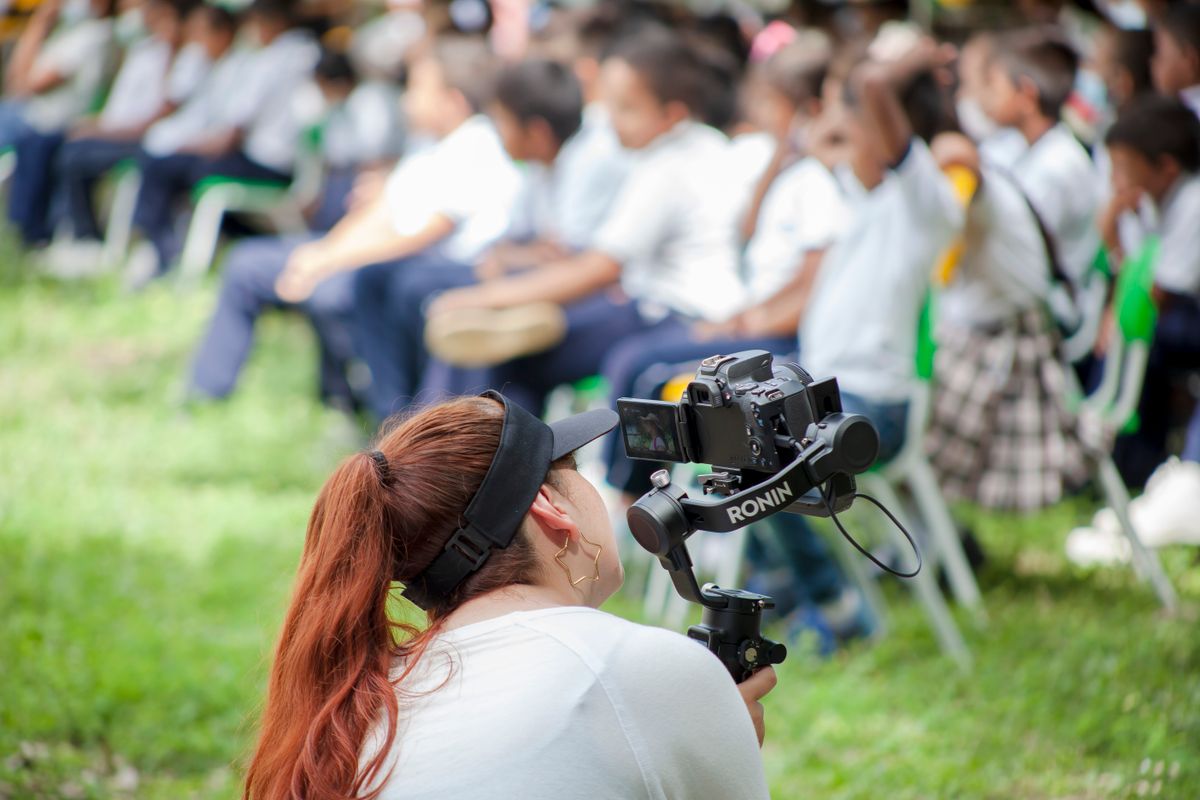
One camera, wide, on the stage. A phone on a tripod at the back, framed to hold the whole stage with room to spare. Set it, check it, leave it.
A second camera if you have a spare volunteer... closer, for faces. Genuinely better, and entirely optional. A single wide shot streams a complete event.
A laptop at the back running the production, with the operator seated where they can see the stage and the screen at once.
A prepared slide deck of names, in order, advanced as the ceremony proceeds. This is the single highest-value preparation you can do, and it is done the day before.
Audio from the hall's sound system, not from the camera's microphone, wherever that is possible. A phone at the back of a hall records the hall, not the speaker.
The audio problem
Worth its own section, because it is where school streams most often disappoint.
A camera microphone at the back of a hall picks up the room: air conditioning, shuffling, the person beside it, and, faintly, the child speaking into a microphone forty feet away. The stream sounds like a recording made by someone in the audience, because that is exactly what it is.
If the hall has a sound system, take audio from it. That signal is the speaker's microphone, mixed properly, without the room.
If there is no sound system, get a microphone close to the action and accept that this is your main constraint. A phone at the front, used as a camera, is closer than one at the back and will sound better even if the picture is worse.
The general rule: viewers forgive a mediocre picture and switch off for bad audio. If you can only improve one thing, improve the sound.
Permission and privacy
This deserves care, and the answer is mostly to use what your school already has.
Follow your existing media consent policy. Schools have one for photographs. Streaming falls under the same category and should be handled the same way, not invented separately.
Prefer a restricted stream. An unlisted link shared with families, or a stream behind a password, is appropriate for an event full of children. A publicly discoverable stream of a school event is a decision that should be made deliberately, not by default.
Know which children cannot appear. Most schools have a list. The practical implication is about camera framing and where those children stand, and it must be settled before the event, not during it.
Say what you are doing. Tell families in advance that the event will be streamed and how to watch. It is courteous, it is usually required, and it substantially increases how many people actually watch.
Things that go wrong at school events
From the pattern of what people report:
The event starts late and the stream started on time. Remote viewers watch an empty stage and drift away. Start the stream close to the actual start, or show a holding slide with the expected start time.
Nobody knew it was happening. The link went out once, days earlier, in an email that also contained six other things. Send it again on the day.
The camera got knocked. A tripod at the back of a hall full of moving people is vulnerable. Tape the legs, put it somewhere protected, and check the frame after the audience is seated.
It ran long and stopped early. School events overrun. Do not schedule a hard stop.
The recording was lost. The most painful one, because it cannot be repeated. Verify the recording is running at the start rather than assuming, and check the file afterwards before anyone dismantles anything.
The wider case
Once a school has done this once, it usually keeps going, because the events are already there: assemblies, concerts, sports days, drama productions, parent evenings.
The setup does not change. One or two cameras, a laptop, a prepared deck, audio from the desk. Once a teacher has run it successfully, the second event is straightforward and the tenth is routine.
And the reason it is worth the effort is not the technology. It is a grandparent in another country watching a child collect a prize at the moment it happens. That is an unreasonably good outcome for a phone on a tripod at the back of a hall.